

Environmental sustainability and the drive towards a more circular economy have challenged manufacturers to rethink product designs and question traditional material choices. One such traditional material choice is thermoset rubber, commonly used in applications requiring elastic, damping or sealing properties.
Why Manufacturers Are Moving Away from Thermoset Rubber
Is TPE a Sustainable Rubber Alternative?
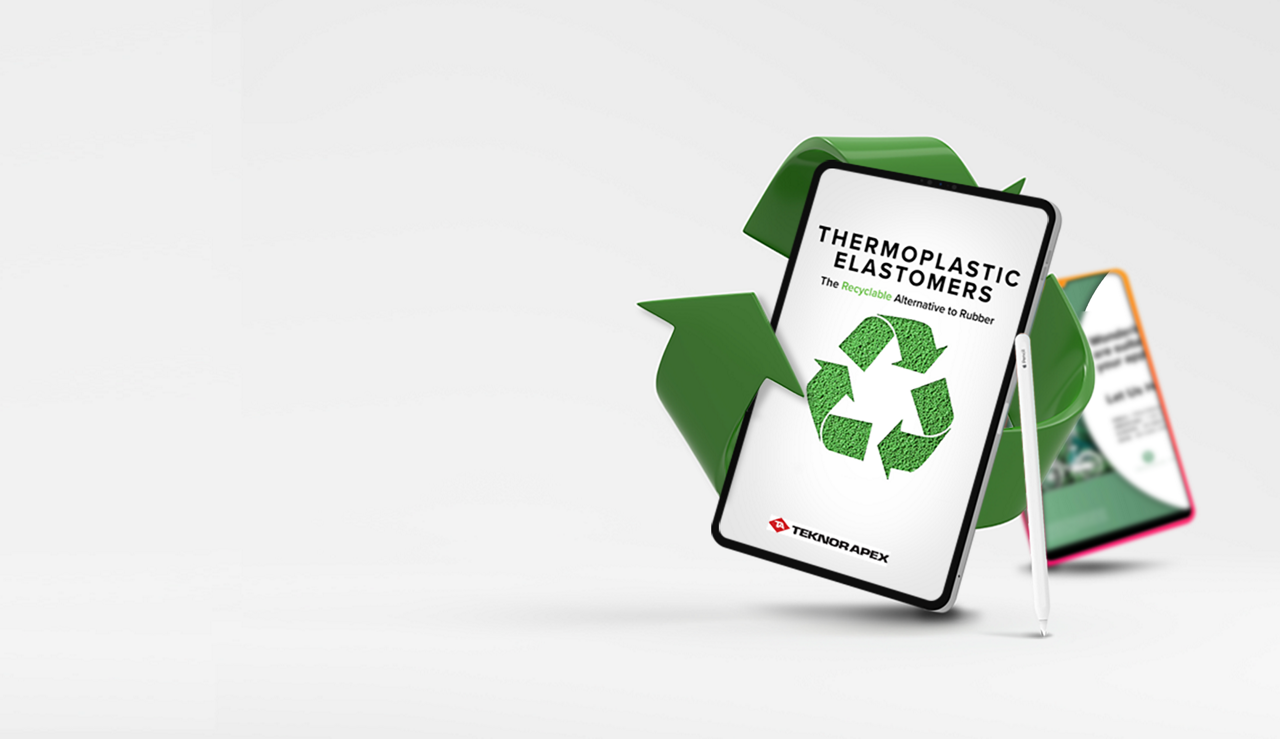
Thermoplastic Elastomers, or TPEs, are the primary alternative to thermoset rubber, and exhibit many of the same characteristics. However, TPEs offer several key advantages over rubber regarding sustainability, design freedom, performance and cost. In terms of environmental sustainability and the circular economy, TPEs offer recycling opportunities not possible with thermoset rubber. We’ve created this eBook to help manufacturers looking for sustainable alternatives to rubber, hoping to provide some insight about the recyclability of TPEs and guidance on determining if TPEs are the right fit.
Download the eBook for an in-depth look at the topics below and feel free to contact us if you have any questions.
Thermoplastic Elastomer vs Rubber: What’s the Difference?
Over time, Thermoplastic Elastomers, or TPEs, have continuously replaced thermoset rubber materials like EPDM, silicone, and latex, in applications across many industries. Although these materials behave similarly when in their final molded or extruded form, their differences on a molecular level allow for TPEs to be readily recycled.
Environmental Impact: How TPE Recycling Supports a Circular Economy
The environmental impact of material selection extends beyond performance and cost. Unlike thermoset rubber, TPEs offer recycling and reuse opportunities that reduce waste, improve material efficiency, and support circular economy goals.
Learn more about why the recyclability of TPEs is important and what opportunities are available, as we explore the following topics:
- Circular Economy
- Recycling Options
- Recycling TPEs
- Loop Opportunities
Is TPE Recyclable? How TPE Recycling Works
Thermoplastic elastomers (TPEs) are inherently recyclable because, unlike thermoset rubber, they do not undergo irreversible chemical crosslinking during processing. This means TPE scrap can be reheated, remelted, and reprocessed multiple times using conventional thermoplastic manufacturing methods. In contrast, thermoset rubber forms permanent crosslinks during curing, preventing it from being reshaped or efficiently recycled.
Common TPE recycling approaches include regrinding and reusing in-plant production scrap, mechanical recycling into new compounds, and in some cases incorporating post-industrial or post-consumer recycled content into new formulations. By enabling material reuse and reducing dependence on virgin raw materials, TPEs support more circular manufacturing models—helping manufacturers minimize waste, improve resource efficiency, and meet sustainability goals without sacrificing performance.
Performance, Cost & Design: Is TPE the Right Rubber Substitute?
Aside from recyclability, there are other factors to consider when switching from thermoset rubber to TPE, like performance, cost, design and process. In some ways TPEs may be limited, but they offer many performance enhancements, as well as increased design and manufacturing flexibility, which can result in overall cost savings. It is important to really understand the end use requirements in order to select the most appropriate TPE material. Teknor Apex offers guidance in this product selection process.
Download this eBook today!
Frequently Asked Questions:
TPE can replace thermoset rubber in many applications, particularly where flexibility, sealing performance, and process efficiency are required. However, thermoset rubber may still be preferred in extreme temperature environments or where very high chemical or compression resistance is critical. Material selection should be based on specific performance requirements.
TPEs are generally more recyclable than silicone rubber because they can be remelted and reprocessed. This supports material reuse and waste reduction. While silicone offers excellent high-temperature performance, it is more difficult to recycle, making TPE a more practical option for applications prioritizing circularity.
Recycled-content TPE can deliver durable performance when properly formulated and processed. In many applications, manufacturers can achieve a balance of mechanical properties and sustainability goals, although performance may vary depending on the source and percentage of recycled material used.
TPEs are widely used across automotive, consumer goods, medical, industrial, and building and construction industries. Common applications include seals, gaskets, grips, soft-touch components, and flexible connectors.
Most TPEs are not biodegradable, but they are recyclable. Their ability to be reprocessed and reused makes them well-suited for circular manufacturing approaches focused on reducing material waste.
Switching to TPE can help reduce carbon footprint in certain applications by enabling recyclability, reducing material waste, and often lowering processing energy requirements compared to thermoset rubber. The overall impact depends on factors such as part design, processing conditions, and supply chain considerations.


Share: